Iron Man and Philosophy by William Irwin & White Mark D
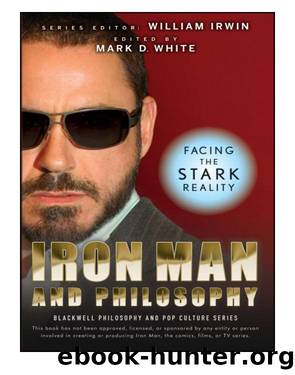
Author:William Irwin & White, Mark D.
Language: eng
Format: epub
Publisher: Wiley
Published: 2010-05-11T00:00:00+00:00
Tony Knows Armor, Tony Knows Women, Tony Doesnât Know Diddley
Okay, so he is not so bad a guy, but is he really a philosopher king or merely a puppet master? Is he, as he says, someone who sees the future and responds, or is he, as Socrates would want, someone who pierces through perception to see the underlying forms that sustain reality and then crafts a world that is best for the soul? This is where Tony Stark scores worseâa lot worse . . .
Socrates was insistent on the need for philosopher guardians to rule because they alone have the knowledge necessary to rule justly. One limitation of the craftsmen and the workers is that their knowledge is partial, particular to their profession and their personal needs. The knowledge of the craft corresponds to what Socrates called technê, and the lower crafts are distinct in that they are essentially material. In other words, the ordinary craftsmanâs knowledge produces something tangible, such as a basket or a ship. The technê employed by philosopher guardians does not produce anything tangible, but, then again, neither does that of teachers (and no one is claiming that teachers should rule). âTrue philosophersâ are different, in that they do not only learn the âpetty crafts,â but they also âlove the sight of truth.â27 Here Socrates argued that while philosopher guardians must know the technê of ruling, this type of knowledge is insufficient to make laws and govern the city in a way that is best for the soul.
Understanding (epistêmê), as opposed to craft, requires knowing the world as it is, the ârealâ reality, a world that is knowable only through contemplation. The famous allegory of the cave describes the intense philosophical journey from a cave of shadows toward a light that reveals the true forms underlying reality.28 A true philosopher is committed to a lifestyle consistent with that allegorical journey: âthe one who readily and willingly tries all kinds of learning, who turns gladly to learning and is insatiable for it, is rightly called a philosopher.â29 Philosophers are literally âlovers of wisdom,â whose love is so great that they cut away all the material obstacles and items that mask the truth, which is to be found in permanent forms. It is only from these forms that justice, beauty, and the good life can be understood. Without understanding these forms, even the person best trained in the craft of ruling would not rule in the way that is best for the souls of the people. Therefore, the philosopher guardian must know the craft of governing and understand the forms, must have technê and epistêmê.
Socrates asked, rhetorically, âSince those who are able to grasp what is always the same in all respects are philosophers, while those who are not able to do so and who wander among the many things that vary in every sort of way are not philosophers, which of the two should be the leaders in a city?â30 He considered those who have âno clear model in their souls and so .
Download
This site does not store any files on its server. We only index and link to content provided by other sites. Please contact the content providers to delete copyright contents if any and email us, we'll remove relevant links or contents immediately.
The remains of the day by Kazuo Ishiguro(9085)
Tools of Titans by Timothy Ferriss(8492)
Giovanni's Room by James Baldwin(7436)
The Black Swan by Nassim Nicholas Taleb(7195)
Inner Engineering: A Yogi's Guide to Joy by Sadhguru(6835)
The Way of Zen by Alan W. Watts(6671)
The Power of Now: A Guide to Spiritual Enlightenment by Eckhart Tolle(5854)
Asking the Right Questions: A Guide to Critical Thinking by M. Neil Browne & Stuart M. Keeley(5831)
The Six Wives Of Henry VIII (WOMEN IN HISTORY) by Fraser Antonia(5558)
Astrophysics for People in a Hurry by Neil DeGrasse Tyson(5224)
Housekeeping by Marilynne Robinson(4504)
Double Down (Diary of a Wimpy Kid Book 11) by Jeff Kinney(4333)
12 Rules for Life by Jordan B. Peterson(4331)
Ikigai by Héctor García & Francesc Miralles(4311)
The Ethical Slut by Janet W. Hardy(4307)
Skin in the Game by Nassim Nicholas Taleb(4306)
The Art of Happiness by The Dalai Lama(4169)
Skin in the Game: Hidden Asymmetries in Daily Life by Nassim Nicholas Taleb(4051)
Walking by Henry David Thoreau(4000)
